
Ahead of it’s time
The story of the Apple Lisa is often reduced to one simple claim: “Apple stole the graphical interface from Xerox.” The real story is far more interesting.
That is why our Lisa exhibition begins long before Apple. We follow the development of the ideas that would eventually shape graphical computing — from Douglas Engelbart, through Xerox PARC, to the Apple Lisa and ultimately the Macintosh. It is not a story of one company simply copying another, but of ideas being developed, challenged, simplified and improved over many years. At the centre of that story is the Lisa 1.
Douglas Engelbart, Mother of all Demos and the Mouse
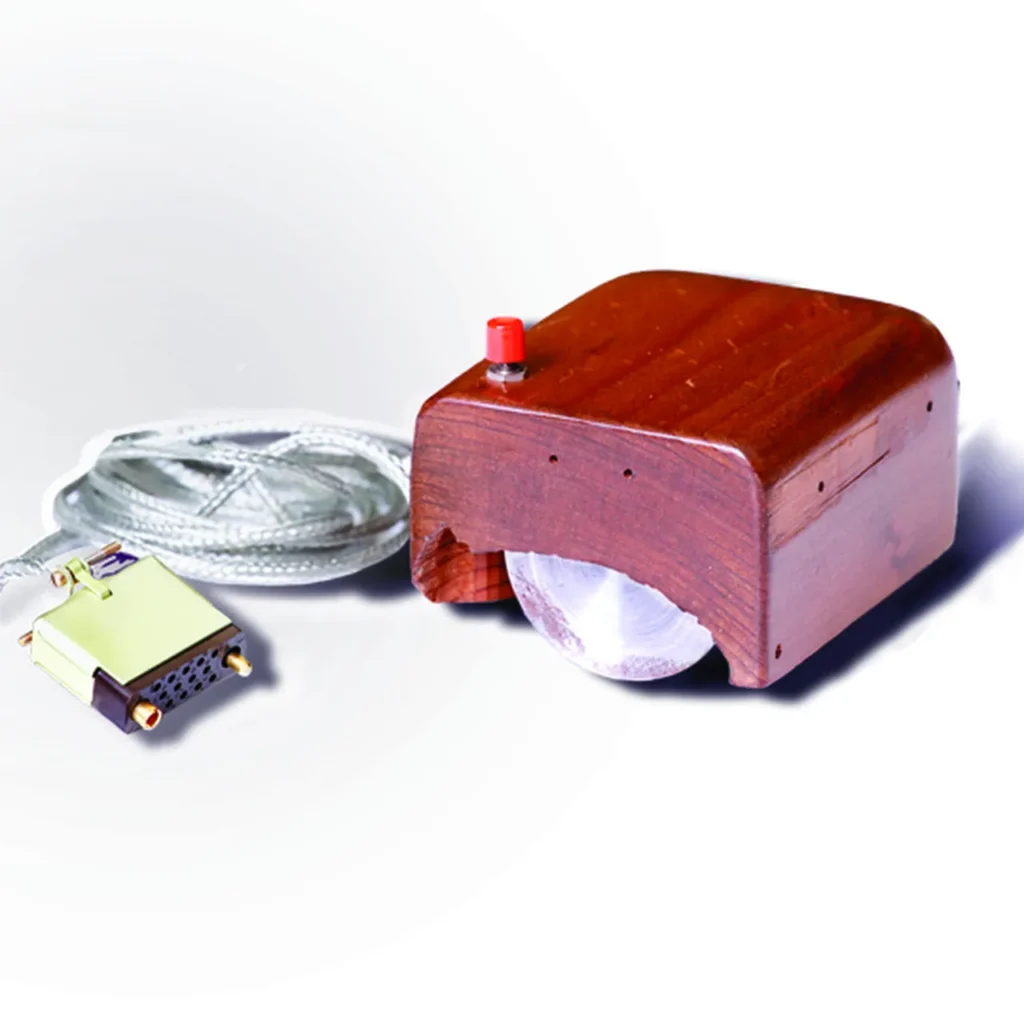
In the early 1960s, Douglas Engelbart began exploring radically new ways for people to interact with computers. In 1964, engineer Bill English built the first prototype of Engelbart’s computer mouse — a small wooden device with two wheels underneath.
On 9 December 1968, Engelbart presented his experimental NLS system during a remarkable 90-minute demonstration in San Francisco that later became known as “The Mother of All Demos.” Using NLS, Engelbart demonstrated a mouse-controlled pointer, hyperlinks, multiple windows, real-time text editing, document sharing, collaborative working and live audio and video communication. Many of the concepts he demonstrated anticipated what we now know as email, chat, websites, videoconferencing, online collaboration, Ethernet and the modern graphical user interface. At
The Apple Museum, visitors can see a replica of Engelbart’s original wooden mouse and watch a short excerpt from The Mother of All Demos.
You can also watch the full 1968 demonstration on YouTube.

Xerox Alto – The Graphical Computer Takes Shape
In 1973, researchers at Xerox PARC developed the Xerox Alto, one of the first computers designed around the idea of personal, graphical computing. The Alto brought many earlier ideas together in a single machine: a high-resolution bitmap display, a mouse, graphical windows, WYSIWYG text editing and networked communication through Ethernet.
It was an extraordinary computer, but it was still primarily a research system. Using it often required a combination of a three-button mouse, keyboard commands and special keys. The Alto was never sold as a mass-market personal computer. Instead, it became an experimental platform on which Xerox researchers could explore what graphical computing might become.

Steve Jobs Discovers Xerox PARC
Apple had already started the Lisa project in 1978 as an ambitious new business computer. In 1979, Apple’s Jef Raskin encouraged Steve Jobs to take a closer look at the work being done at nearby Xerox PARC. In December 1979, Jobs and a group of Apple engineers visited the research centre, where they saw a radically different way of working with computers: a graphical screen, windows, menus and a mouse. Jobs immediately recognised its potential and pushed the Lisa project strongly in this new direction. But Jobs would not remain with Lisa long enough to finish it. After conflicts over management and the direction of the project, he was removed from direct control of the Lisa team. The Lisa was completed without Steve Jobs.
The Team Behind Lisa
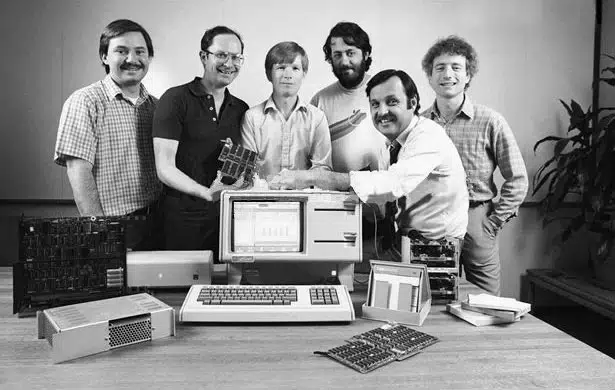
John Couch led the Lisa division, while Wayne Rosing oversaw engineering, Bruce Daniels played a key role in systems software and architecture, and Larry Tesler led important work on applications, interface design and user testing. Bill Atkinson became one of the key architects of Lisa’s graphics and developed the software that evolved into QuickDraw.
Together, the team spent years turning experimental graphical-computing ideas into a coherent system that ordinary people could learn to use. They simplified interaction around a single-button mouse, pull-down menus, double-clicking and direct manipulation of objects on the screen. Lisa’s graphical desktop presented documents, folders and a trash can as familiar objects rather than abstract computer commands. When the Lisa 1 was introduced in January 1983, the result was far more than an Apple version of what Jobs had seen at Xerox. It was the product of years of engineering, interface design, experimentation and user testing by the Lisa team itself.

Twiggy Drives
When the Lisa 1 was introduced in January 1983, it used two of Apple’s own 5.25-inch FileWare drives, better known as: Twiggy. Each disk could store about 851 KB — an unusually high capacity for a floppy-based personal computer at the time.
Apple achieved this with a technically ambitious design. The Twiggy disk was double-sided, used a high track density and varied its rotation speed depending on the position of the read/write head, allowing more data to be stored on the outer tracks than on the inner ones. Impressive on paper, but the drives proved unreliable.
In 1984 Apple offered existing Lisa 1 owners a free conversion to the Lisa 2 – the two Twiggy drives were replaced by a single, reliable Sony 3.5-inch floppy drive and a new front. As a result, most Lisa’s were converted to Lisa 2. Several Lisa 2’s in The Apple Museum’s own collection started life as Lisa 1.
There is no authoritative worldwide census. Computer historian David Greelish estimates that around 90 Lisa 1-derived machines may survive, of which approximately 60 are mostly complete and around 35 are operational or readily restorable. These figures include machines that may have been converted or no longer retain their original Twiggy drives.
The Apple Museum displays a complete, unconverted Lisa 1 with both original Twiggy drives.

A Second Life for the Lisa and the graveyard
After Apple discontinued the Lisa in April 1985, thousands of machines were acquired by Sun Remarketing in Logan, Utah, a company specializing in surplus and discontinued Apple hardware.
Rather than simply reselling them, Sun upgraded the Lisas with newer 800 KB floppy drives, larger hard drives and MacWorks Plus, software that allowed them to run Macintosh applications. Some were sold as the Lisa Professional, giving Apple’s unsuccessful computer an unexpected second life.
But not all of them were saved.
In September 1989, Apple reclaimed approximately 2,700 remaining Lisas that had been consigned to Sun Remarketing. More than twenty truckloads were taken to a landfill in Logan, Utah, where the computers were destroyed and buried under supervision to financially write off its value.
Today, surviving Lisa 1s are among the rarest and most historically significant Apple computers.


You might also like
Discover related articles to the one you just read.


